Architype
Creating a digital blueprint for the smart home of the future
By Kirstin Assheton
The smart home of the future is not about more technology. It is about more independence.
The housing crisis is not merely about not having enough housing provision, it’s about having the right housing provision to withstand public health challenges, an aging population, climate change and the appropriate use of technological advancement.
Most people do not think of their home as a care setting in the traditional sense of the word, but many would agree that the home should provide comfort, familiarity, privacy and independence.
So how can the home provide greater comfort, safety and support, while helping people remain independent, connected and in control of their own lives?
Architype has recently been involved in an innovative research and development project to support pathfinding for this: ENVISION – The Digital Blueprint for a Smart Home of the Future.
ENVISION was produced by the Digital Health & Care Innovation Centre as part of the Rural Centre of Excellence for Digital Health & Care Innovation, funded by the UK Government through the Moray Growth Deal. The project was developed in partnership with BE-ST, University of Strathclyde, Moray Council, Architype, Evolve Capex and The Alternative UK.
Together, the project team has explored how housing could respond to some of the most pressing challenges facing Scotland and the wider UK: ageing, health inequality, rural access to services, fuel poverty, net-zero and pressure on health and care systems.
A Blueprint, not a product
The ‘Smart’ and ‘Digital’ titles to this project garner equal measures of intrigue and wariness. It’s important to know that ENVISION is not a smart home ‘product’, nor is it a fixed specification telling clients, designers or housing providers exactly what to build. It is best understood as a framework: a set of tools, ideas and design principles that can help different organisations explore what smarter, healthier homes might mean in their own context.
The blueprint includes three interconnected elements:
- a guide – setting out the wider policy, research and contextual thinking
- a detailed matrix – providing a more detailed way of exploring different measures and ambition levels
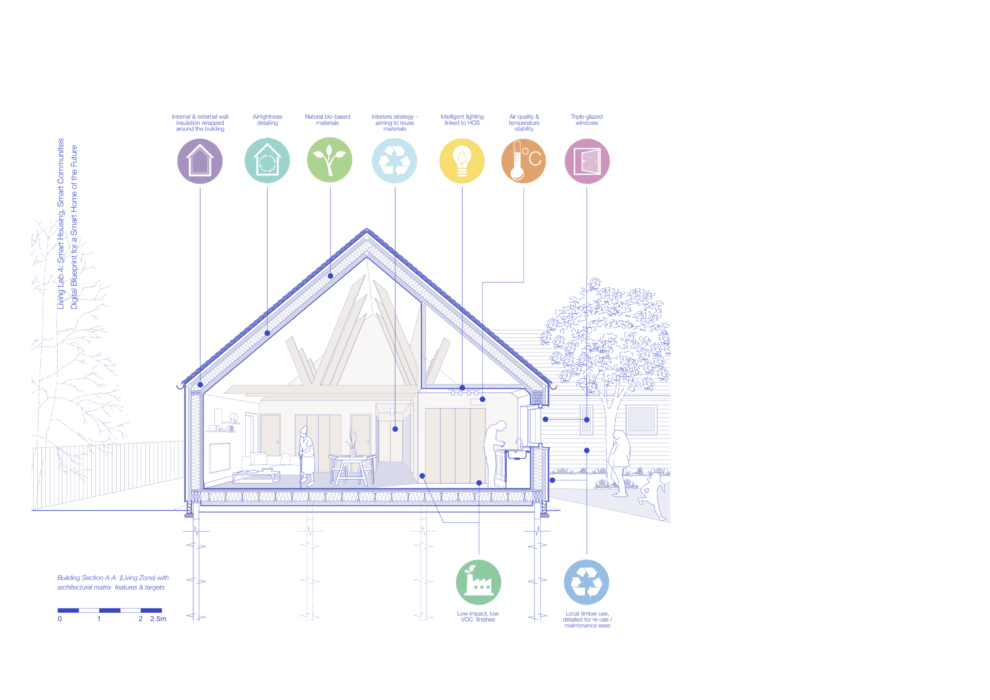
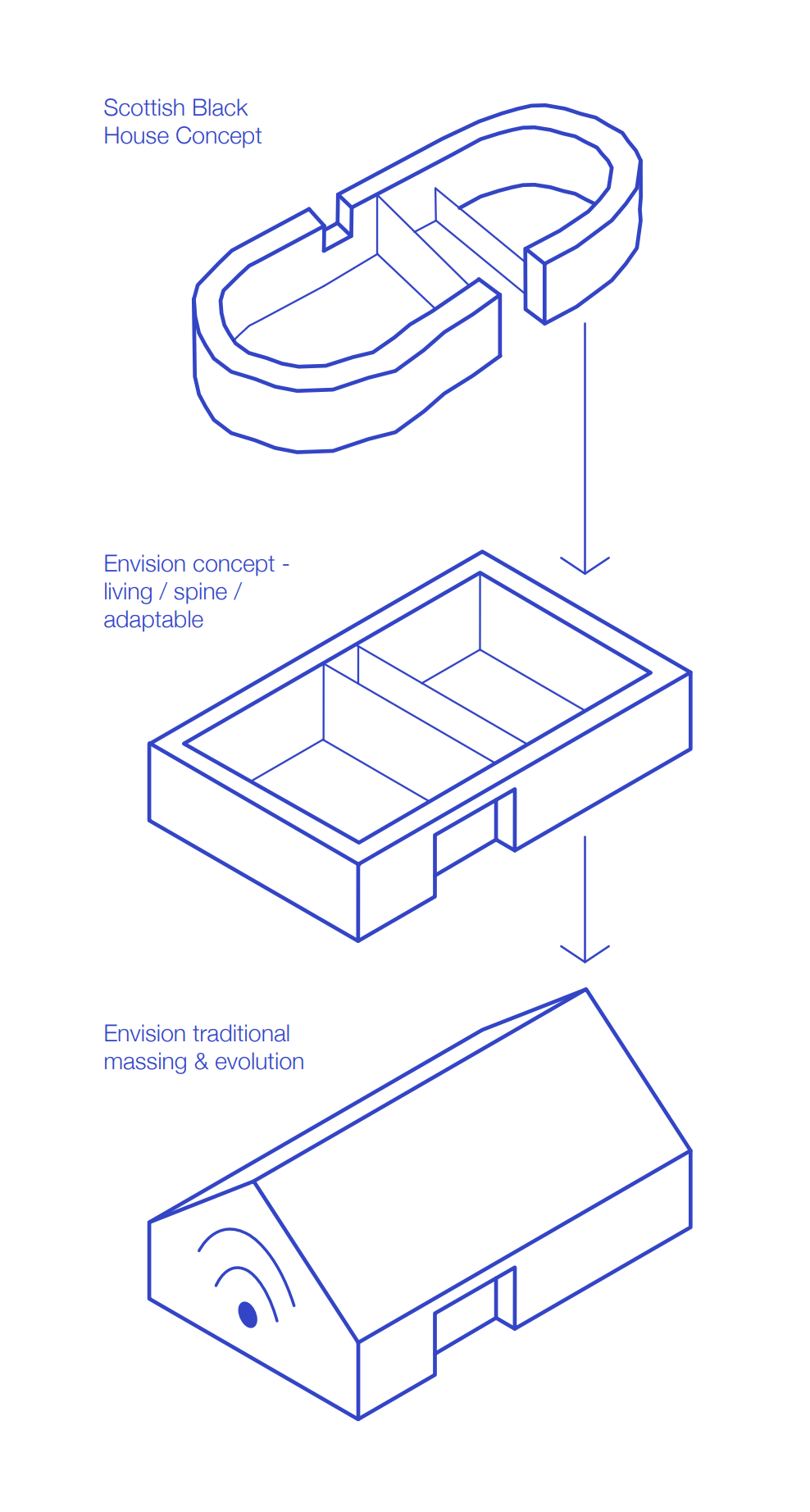
- and a strategic architectural and technology model, which brings the thinking into spatial and architectural form, showing how design and technology could come together in a future home.
These three elements are supported by a detailed affordability annex, prepared by Evolve Capex.
They say ‘all good things come in threes. The next trio to highlight is the Three Horizons, for which this framework is structured around, helping users think about what is possible now, what might be achievable in the medium term, and what longer-term innovation could look like. It also invites organisations already at different stages of the process to enter at appropriate horizon points rather then start from the very beginning. This positions the project practical tool for planning, testing and decision-making – starting now.
That flexibility and entry point accessibility is important for ENVISION. For instance;
- A housing association might be most interested in the matrix as a way to think about resident wellbeing, asset resilience and long-term investment.
- A local authority might use the guide to explore how housing, health and care strategies could be better aligned.
- A designer or developer might be drawn to the architectural model as a way of understanding how smart technologies can be integrated without compromising the quality, simplicity or dignity of the home.
A more human smart home
The phrase “smart home” conjures images of gadgets. But the ENVISION project asks how technology can become a quiet support system: helping to monitor the performance of the home, identify changes in wellbeing, support continuity of care and enable better decisions by residents, families, housing providers and health professionals.
The Smart Homes Digital Blueprint integrates health and data technologies with adaptable design; focusing on autonomy, self-advocacy, social connection and reducing pressure on acute health services.
But the ambition is not to turn the home into a clinical environment. Quite the opposite. The value of the smart home lies in its ability to provide reassurance without removing agency; and to make care and support feel less disruptive, less institutional and more embedded in everyday life.
Why design matters
This is where architecture has an important role to play.
Digital health and care technologies can offer powerful possibilities, but they need to be integrated into homes in ways that are spatially, socially and environmentally viable. A sensor strategy alone does not create a good place to live.
Architype’s contribution was to translate ideas around health, care, ageing, data, digital infrastructure, low-carbon design, affordability and rural resilience into a clear architectural framework, informed by our long-standing experience in sustainable housing, Passivhaus, retrofit and evidence-led design.
For Architype, the project sits naturally within a growing body of research and innovation work, where design is developed alongside academics, technical specialists and sector experts.
Our role was not to make the home more complicated, but to help make complexity seamlessly integrated and useful. That reflects a central part of our design ethos: elegant simplicity. The smart home of the future should not feel over-engineered or difficult to understand. It should feel calm, legible and human. It should use design and technology to support daily life, not dominate it.
Rural context, wider relevance
With the project backed by the Moray Growth Deal, the ENVISION project has a particular rural relevance. Rural and remote communities often experience challenges around access to services, transport, healthcare, digital connectivity and ageing in place. These conditions make the relationship between housing, health and care especially important.
In rural contexts, the home can play an even greater role in supporting independence. Enabling people remain in their community for longer, reduce unnecessary travel or intervention and provide better insight into both building performance and resident wellbeing.
However, the relevance of ENVISION extends well beyond Moray. The questions it raises are becoming increasingly important for all local authorities, housing associations, retirement living providers, designers, health and care organisations, policymakers and funders across the UK.
Looking forward
One of the strengths of ENVISION is that it does not pretend there is a single answer. Instead, it creates a structured way to ask better questions.
The blueprint recognises that different organisations will be at different stages of readiness. Some may be exploring immediate interventions that could improve comfort, safety and energy performance now. Others may be thinking about medium-term investment, service integration or new housing models. Eventually we all need to be looking at housing provision that is deeply connected to health systems, digital infrastructure and predictive care.
For Architype, this is also where sustainable design and digital innovation need to meet. Homes that support health and independence must also be affordable to heat, resilient to climate change and designed with environmental integrity.
The smart home of the future should not ask people to give up autonomy in exchange for support. It should make independence easier to sustain.
That is the promise of ENVISION: not a finished answer, but a practical and generous framework for imagining, testing and shaping homes that do more for people, places and the planet.
Kirstin Assheton is an Associate and Passivhaus designer at Architype.
The Digital Health & Care Innovation Centre are working with 6 early adopters/pathfinders developing a range of approaches to the adoption of the blueprint for both retrofit and new build projects. The early adopter group includes housing associations, a local authority and specialist housing providers. For more information, contact Kirstin kirstin.assheton@architype.co.uk